
Author name: launcheaze

Uncategorized

Income Tax Notice

Receiving a notice from the Income Tax Department can be stressful, but it’s important to understand that it doesn’t always mean something is wrong or illegal. Notices may be issued for simple information requests, mismatched data, or assessments. Responding correctly and on time is key to resolving any issue peacefully and legally. This guide explains the types of income tax notices, their reasons, how to respond, and tips to avoid them in the future. What is an Income Tax Notice? An Income Tax Notice is a formal communication sent by the Income Tax Department of India to a taxpayer. It may be issued for multiple reasons such as: Notices are usually sent under different sections of the Income Tax Act, 1961, depending on the nature of the query or issue. Common Reasons for Receiving an Income Tax Notice Types of Income Tax Notices Let’s look at the most common types of notices and the relevant sections under which they are issued: 1. Notice under Section 143(1) – Intimation Notice This is not exactly a “notice” but an intimation about: Issued automatically after processing your return. No response is needed if everything matches. But if there is a tax demand, pay it within 30 days. 2. Notice under Section 142(1) – Inquiry Before Assessment This is sent when the Assessing Officer wants: You must respond within the time limit to avoid penalty or best judgment assessment. 3. Notice under Section 143(2) – Scrutiny Assessment This notice is issued when your return is selected for detailed scrutiny. The department suspects: You need to appear before the Assessing Officer or submit documents online. 4. Notice under Section 148 – Reassessment Issued when the department believes income has escaped assessment. Common in cases where: This can be issued up to 10 years after the relevant assessment year (in case of income above ₹50 lakh escaping assessment). 5. Notice under Section 156 – Demand Notice If tax, penalty, or interest is payable, this notice is issued. The amount must be paid within 30 days to avoid further consequences. 6. Notice under Section 139(9) – Defective Return Your return is considered “defective” if: You need to rectify and re-submit the return within 15 days. 7. Notice under Section 245 – Set Off Refund Against Tax Demand This notice is issued when you are eligible for a refund, but have past tax dues. The department seeks your approval to adjust the refund amount against pending demands. How to Respond to an Income Tax Notice Here’s a step-by-step approach if you receive a notice: Step 1: Don’t Panic Understand that not all notices are negative. Many are just intimations or requests for clarification. Step 2: Read Carefully Check the section, reason, assessment year, and deadline mentioned in the notice. Step 3: Login to Income Tax Portal Go to https://www.incometax.gov.in and log in using your PAN and password. Go to “e-Proceedings” or “View Notices”. Step 4: Collect Documents Get all relevant documents — Form 16, Form 26AS, AIS, bank statements, etc. Step 5: Draft Response or Hire a CA Depending on the complexity, prepare a response or consult a Chartered Accountant or tax expert. Step 6: Submit Online Most notices allow submission of documents and explanations through the e-Filing portal under “e-Proceedings.” Step 7: E-Verify and Follow Up Always e-verify your response and check status regularly. Sample Format: Response to Notice textCopyEditTo, The Assessing Officer, Income Tax Department Subject: Response to Notice under Section 143(2) for AY 2024-25 Dear Sir/Madam, This is with reference to the above-mentioned notice received on [Date] regarding scrutiny of Income Tax Return for AY 2024–25. I have enclosed the following documents as required: 1. Salary slips 2. Form 16 3. Investment proofs 4. Rent agreement, etc. Kindly acknowledge the submission. Please feel free to contact for any further clarification. Thank you. Yours sincerely, [Your Name] [Your PAN] [Mobile Number] How to Avoid Income Tax Notices Legal Consequences of Ignoring Notices Ignoring notices can result in: So always respond within the time frame mentioned. FAQs About Income Tax Notices Q1: Can I receive a notice even if I have filed my return correctly? Yes. Scrutiny can be random or due to third-party data mismatch, like high spending vs declared income. Q2: Is a notice the same as a demand? No. A demand notice asks you to pay outstanding tax. A regular notice may just request information. Q3: Can I respond to a notice without a CA? Yes, if the matter is simple. But for scrutiny, reassessment, or penalty-related notices, it’s better to hire a professional. Q4: What if I miss the deadline to respond? You can request an extension, but ignoring it completely may lead to legal actions or penalties. Q5: Can notices be sent by email or SMS? Yes. Notices are now sent through the e-filing portal, registered email, and SMS. Always keep your contact details updated. Conclusion Getting an Income Tax Notice doesn’t necessarily mean you are in trouble. Many notices are simply informative or routine queries. The key is to read the notice carefully, understand the reason, respond promptly, and maintain clean and accurate financial records. With digital tools, online responses, and proper documentation, most issues can be resolved easily. If you’re unsure, don’t hesitate to consult a tax advisor. Stay informed, stay compliant.


Uncategorized

Income Tax Refund

An Income Tax Refund is a financial return from the government to a taxpayer when excess tax has been paid over the actual tax liability. In simple terms, if you’ve paid more tax than you were required to—through TDS, advance tax, or self-assessment tax—you are eligible for a refund after filing your Income Tax Return (ITR). This guide explains the concept of income tax refund in India, eligibility, filing process, status check, refund delays, and frequently asked questions. What is Income Tax Refund? A tax refund arises when the tax paid by a taxpayer is higher than their actual tax liability for the financial year. This could happen due to: After filing the ITR and assessment by the Income Tax Department, if it is determined that you paid more tax, a refund is issued to your bank account. Who Can Claim a Refund? Any taxpayer—individual, company, partnership, HUF, or NRI—can claim an income tax refund if: When and How to Claim an Income Tax Refund You can claim a refund only after filing your Income Tax Return (ITR) for the relevant Assessment Year. The Income Tax Department processes the return and calculates the refund automatically. Steps to Claim Income Tax Refund: Note: You must file ITR before the deadline (usually 31st July for individuals) to claim a refund. Documents Required to Claim Refund How to Check Income Tax Refund Status Once your ITR is processed and the refund is issued, you can track its status online. Method 1: Income Tax e-Filing Portal Method 2: NSDL Refund Tracking Time Taken to Get Income Tax Refund As per the Income Tax Department, refunds are usually processed within: Faster processing is possible if: Why Income Tax Refund May Be Delayed Refunds may be delayed due to: You can raise a grievance on the e-filing portal or contact the Centralized Processing Centre (CPC) at Bengaluru if there’s an unusual delay. Interest on Income Tax Refund Under Section 244A, if your refund is more than 10% of the total tax paid, you are eligible to receive interest at 0.5% per month (6% per annum) for the delay in receiving the refund. The interest is calculated from: Note: Interest received on refunds is taxable and should be declared in next year’s ITR under “Income from Other Sources.” How to Revise ITR for Higher Refund If you forgot to claim deductions or made an error, you can file a Revised Return under Section 139(5). This can increase your eligible refund amount. Refund Reissue Request If your refund failed due to incorrect bank details or closure of bank account, you can request a Refund Reissue. Steps: Common Mistakes to Avoid FAQs on Income Tax Refund Q1. Is filing ITR necessary to get a refund? Yes, filing ITR is mandatory to claim any refund from the Income Tax Department. Q2. How will I receive the refund? Refund is directly credited to your bank account via ECS. Ensure bank details and IFSC code are correct. Q3. What if I don’t receive my refund? You can raise a refund reissue request or contact CPC if the delay exceeds 45 days. Q4. Is refund taxable? Only the interest on refund (Section 244A) is taxable, not the refund amount itself. Q5. Can I get a refund if I filed ITR after the due date? Yes, but interest under Section 244A may not be paid for delayed filings. Conclusion Claiming an Income Tax Refund is your right as a taxpayer if you’ve overpaid taxes during the financial year. It is important to file your ITR accurately and on time, maintain proper records, and regularly check your refund status. With digital systems and faster processing by the Income Tax Department, refunds are now easier and quicker than ever before. Take advantage of this system to optimize your personal or business cash flow and maintain good financial health.

Uncategorized

Income Tax Return

Filing an Income Tax Return (ITR) is a crucial financial responsibility for individuals, businesses, and other entities. In India, the Income Tax Department under the Ministry of Finance governs income tax laws and collects revenue for public services and development. This guide provides a comprehensive understanding of what an ITR is, why it’s important, types of ITR forms, filing procedures, benefits, and common FAQs. What is an Income Tax Return (ITR)? An Income Tax Return is a form used to report an individual’s or a business’s annual income, deductions, taxes paid, and other financial information to the Income Tax Department of India. Based on the details submitted, the department assesses whether additional taxes are owed or if a refund is due. Filing is mandatory if your gross total income exceeds the exemption limit set by the government. Even if it’s not mandatory in your case, filing ITR has several benefits. Who Should File an ITR? You must file an ITR if: Types of ITR Forms There are different ITR forms based on the nature and amount of income: 1. ITR-1 (Sahaj) For individuals earning: 2. ITR-2 For individuals and HUFs not having income from business/profession. 3. ITR-3 For individuals and HUFs having income from business or profession. 4. ITR-4 (Sugam) For presumptive income (under Sections 44AD, 44ADA, and 44AE). Suitable for small businesses or professionals with turnover up to ₹2 crore. 5. ITR-5 For partnerships, LLPs, AOPs, BOIs, and others. 6. ITR-6 For companies (except those claiming exemption under section 11 — income from property held for charitable purposes). 7. ITR-7 For persons including trusts, political parties, or institutions claiming exemptions. Due Dates for Filing ITR Category Due Date (AY 2024-25) Individual / HUF (non-audit) 31st July 2024 Audit Cases (Business/Profession) 31st October 2024 Companies 31st October 2024 Note: Late filing attracts interest under Section 234A and a penalty up to ₹5,000. Steps to File Income Tax Return Online Key Documents Required Benefits of Filing ITR 1. Loan and Visa Approvals ITR is a mandatory document for processing home loans, car loans, and even applying for visas. 2. Claim Tax Refund If excess tax is deducted (TDS), filing ITR helps claim the refund. 3. Avoid Penalties Filing ITR on time avoids legal penalties and interest. 4. Carry Forward Losses You can carry forward capital/business losses only if you file ITR on time. 5. Legal Proof of Income ITR serves as income proof, especially for self-employed individuals. Common Mistakes to Avoid Consequences of Not Filing ITR New Updates and Changes (As of AY 2024-25) FAQs About Income Tax Return Q1. Is it mandatory to file ITR if my income is below the exemption limit? No, but you should file voluntarily to claim refunds or keep records. Q2. What is the penalty for not filing ITR? A late fee up to ₹5,000 and interest on due tax may be levied. Q3. How can I correct a mistake in my filed ITR? You can file a Revised Return before the due date for the next assessment year. Q4. Is ITR filing necessary for NRIs? Yes, if they earn taxable income in India. Q5. Can ITR be filed manually? Manual filing is allowed only in specific cases. Most individuals must file online. Conclusion Filing your Income Tax Return is not just a legal duty — it is a reflection of your financial discipline and responsibility. Whether you’re a salaried individual, freelancer, businessman, or investor, filing ITR accurately and on time can save you from future hassles and ensure smooth financial planning. Use government tools like the ITR utility and consult a tax expert if needed.

Uncategorized

GST Notice

The Goods and Services Tax (GST) regime in India is designed to ensure tax compliance through transparency, digitization, and real-time monitoring. One of the mechanisms used by the government to ensure this compliance is the issuance of GST Notices. If you’re a registered GST taxpayer, receiving a notice from the GST department may seem alarming—but it’s also common. This article explains what a GST notice is, its types, why it is issued, how to respond to one, possible penalties, and best practices to avoid receiving one in the first place. What is a GST Notice? A GST notice is a formal communication issued by GST authorities to taxpayers when there is a discrepancy, non-compliance, delay, under-reporting, or suspicion of tax evasion. It serves as an intimation that the taxpayer needs to either provide clarification, pay outstanding dues, or correct a mistake. Notices are sent electronically on the GST Portal and also via email or SMS linked to the taxpayer’s GST registration. Reasons for Receiving a GST Notice Some of the most common reasons include: Types of GST Notices There are several kinds of notices a registered person may receive. Here are the most common ones: 1. GSTR-3A Notice – Non-Filing of Returns Issued when a taxpayer fails to file monthly or quarterly GST returns within the due date. It’s an intimation to comply before penalties are levied. Action: File the pending returns immediately to avoid penalties and late fees. 2. Notice under Section 61 – Scrutiny of Returns Issued when discrepancies are found in GSTR-1 and GSTR-3B or other returns. Example: Your GSTR-1 shows ₹10 lakh in sales, but GSTR-3B reflects only ₹8 lakh. Action: Respond with supporting documents or correct the returns if a genuine error exists. 3. Notice under Section 65 – Audit by Tax Authorities Issued when the department conducts a tax audit of your business to check records and compliance. Action: Cooperate with the audit and furnish required records—like books of accounts, invoices, and reconciliation statements. 4. Notice under Section 67 – Inspection/Search/Seizure Issued when the department suspects tax evasion, fraud, or suppression of turnover. Action: Serious in nature—consult a GST consultant immediately and ensure all documents are in order. 5. Notice under Section 73 – Tax Not Paid/Short Paid (Without Fraud) Issued when tax has not been paid or short paid without fraudulent intention or suppression of facts. Time limit: Within 3 years from the due date of filing the annual return. Action: Pay tax with interest, or reply with evidence to defend your case. 6. Notice under Section 74 – Tax Not Paid (With Fraud) Issued when tax is unpaid or underpaid with intention to evade tax, fraudulent documentation, or suppression. Time limit: 5 years from the due date. Action: Serious consequences. Legal assistance is recommended. 7. Show Cause Notice (SCN) A notice asking the taxpayer to explain why action (penalty, recovery, or cancellation of registration) should not be taken. Example: “Why should your registration not be cancelled for non-filing of returns for 6 months?” Action: Provide a satisfactory reply with documentation within the stipulated time. 8. ASMT-10 – Discrepancy in Return Scrutiny Issued when the officer finds inconsistencies during return scrutiny. Example: ITC claim is much higher than eligible credit as per GSTR-2B. Action: Respond within 15 days using form ASMT-11, along with explanations and records. 9. REG-03 – Clarification on GST Registration Application Issued when the GST officer requires additional details for registration approval. Action: Respond via REG-04 within 7 working days. 10. CMP-05 – Composition Scheme Violation Issued to composition scheme taxpayers found ineligible or violating rules. Action: Respond with justification or shift to regular taxpayer status. How to Respond to a GST Notice Step 1: Read Carefully Login to the GST portal, download the notice, and read it thoroughly. Understand the section number, reason, and required response. Step 2: Consult Your Accountant or GST Practitioner Engage a qualified professional to evaluate the issue and draft a response. Step 3: Prepare the Response Prepare a written reply, attach relevant documents like: Step 4: File the Reply Online Most notices have to be responded to through the “View Notices and Orders” section on the GST portal. Step 5: Keep Acknowledgment Save the acknowledgment, screenshots, and final response PDF for your records. Penalties for Not Responding to GST Notices Failure to respond or comply with a GST notice may lead to: How Accountants and Tax Consultants Help ✅ Analyze the Notice A professional can interpret complex legal language and identify the issue. ✅ Draft Accurate Responses Helps prepare well-structured replies with correct formats and attachments. ✅ Represent Before Authorities In some cases, a Chartered Accountant or GST Practitioner can represent you during hearings. ✅ Preventive Compliance Accountants ensure timely return filing, correct ITC claims, and avoid future notices. Best Practices to Avoid GST Notices Conclusion Receiving a GST notice is not necessarily a cause for panic. It’s a part of the government’s tax monitoring and compliance procedure. What’s important is how timely and accurately you respond to it. Whether it’s a minor discrepancy or a serious audit issue, always consult a qualified GST accountant or practitioner. Staying proactive, maintaining proper records, and adopting sound accounting practices can help you avoid GST notices, minimize risks, and keep your business compliant.

Uncategorized

GST Return Filing by Accountant

In India’s Goods and Services Tax (GST) regime, return filing is a crucial compliance requirement for every registered business. The process involves the reporting of sales, purchases, input tax credit (ITC), and tax liability to the government. For many businesses, especially small and medium enterprises (SMEs), the GST filing process can be complex. That’s where accountants and GST practitioners play an essential role. This guide explains everything you need to know about GST return filing by an accountant – from the types of returns, responsibilities of the accountant, process, documents required, and benefits of professional help. What is GST Return Filing? A GST return is a document that contains details of all income, sales, purchases, and taxes paid or collected by a taxpayer. It must be filed online on the GST portal (www.gst.gov.in) regularly, depending on the type and size of the business. There are various types of GST returns, and different businesses are required to file different returns monthly, quarterly, or annually. Role of an Accountant in GST Return Filing An accountant or GST practitioner assists businesses in managing their GST compliance effectively. Their role includes: Hiring a professional ensures accuracy, legal compliance, and peace of mind, especially when rules are frequently updated. Types of GST Returns Filed by Accountants An accountant usually handles the following GST returns on behalf of businesses: 1. GSTR-1 (Monthly or Quarterly) 2. GSTR-3B (Monthly or Quarterly) 3. GSTR-4 (Annually) 4. GSTR-9 (Annually) 5. GSTR-9C 6. GSTR-7 and GSTR-8 GST Return Filing Process by an Accountant Step 1: Data Collection The accountant collects the following from the client: Step 2: Data Reconciliation This step involves matching: Step 3: Preparing Returns The accountant prepares the applicable return(s) based on the turnover and business type. Step 4: Client Review The draft return is shared with the business owner for confirmation before final submission. Step 5: Filing Returns Returns are filed on the GST portal using the client’s login credentials and Digital Signature Certificate (DSC) or Electronic Verification Code (EVC). Step 6: Acknowledgment and Payment Once filed, a confirmation is received along with a Challan (GST PMT-06) if tax payment is required. Documents Required for GST Return Filing To file GST returns accurately, the following documents are typically required: Accountants may use this data to prepare ledgers and match it with returns to ensure there are no mismatches. Benefits of Hiring an Accountant for GST Return Filing 1. Expertise An experienced accountant is well-versed in changing GST laws and knows how to apply the correct rules, tax rates, and exemptions. 2. Error-Free Filing Mistakes in GST filing can lead to notices, penalties, and even denial of ITC. An accountant reduces this risk. 3. Timely Compliance Late filing attracts heavy penalties. Accountants ensure all returns are filed on or before due dates. 4. Better ITC Management Proper reconciliation ensures the business gets the maximum eligible Input Tax Credit without rejection. 5. Responding to GST Notices Accountants can represent the business and reply to any GST department inquiries or notices efficiently. 6. Record Maintenance Books of accounts, ledgers, and tax documents are maintained systematically, aiding in audits or assessments. Penalties for Non-Compliance Late or incorrect return filing attracts: An accountant helps avoid these penalties by ensuring continuous compliance. Cost of Hiring an Accountant for GST Filing Fees vary based on: Typical monthly charges: Annual packages, discounts, and bundled services (like TDS filing, ITR, ROC compliance) may also be available. Choosing the Right Accountant or GST Consultant When selecting a professional for GST filing, ensure they: You can also verify the credentials of a GST practitioner on the GST portal. Conclusion GST return filing is a core compliance activity that businesses cannot afford to neglect. With increasing digitization and strict penalties for non-compliance, having an accountant to manage your GST returns ensures peace of mind, accuracy, and time savings. Whether you’re a startup, trader, service provider, or manufacturer, professional help in return filing can save you from unnecessary financial and legal troubles. By delegating GST tasks to a competent accountant, you can focus more on your business growth while staying 100% compliant with the Indian tax system.

Uncategorized

GST E-Invoicing Software

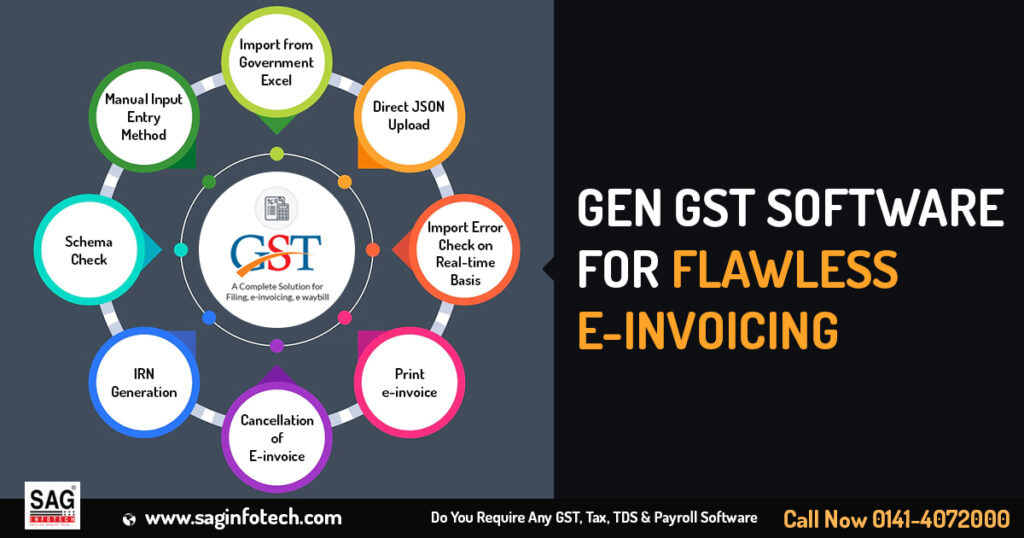
With the evolution of the Goods and Services Tax (GST) system in India, e-invoicing has emerged as a game-changer in digital tax compliance. E-invoicing or Electronic Invoicing under GST mandates businesses to generate invoices through a government-approved portal in a standardized format. To ensure smooth compliance, businesses are increasingly adopting GST e-invoicing software to automate and streamline the process. In this guide, we will explain what GST e-invoicing is, how it works, why businesses need e-invoicing software, and the features you should look for in a good e-invoicing solution. What is GST E-Invoicing? E-invoicing under GST is a system where invoices generated by businesses are electronically authenticated by the GST Network (GSTN). Once verified, a unique Invoice Reference Number (IRN) and QR code are issued. Introduced in phases, e-invoicing is now mandatory for businesses with turnover exceeding ₹5 crores (as of FY 2024-25). The main goal is to: How Does E-Invoicing Work? Here’s a step-by-step breakdown of the e-invoicing process: Why Use GST E-Invoicing Software? While the e-invoicing process can be done manually by uploading invoice JSON files to the government portal, this is time-consuming and error-prone. E-invoicing software simplifies the entire process through automation and system integration. Key Benefits of Using E-Invoicing Software: Features to Look for in E-Invoicing Software Choosing the right e-invoicing software is crucial for ensuring GST compliance and operational efficiency. Here are the top features to consider: 1. IRP Integration Ensure the software is integrated with Invoice Registration Portals for real-time IRN and QR code generation. 2. Bulk Upload The software should allow bulk invoice generation and processing, especially if you issue hundreds or thousands of invoices monthly. 3. ERP Compatibility It should integrate easily with existing ERP or accounting software like Tally, SAP, Zoho Books, QuickBooks, or custom solutions. 4. Auto QR Code & IRN Invoices should automatically be updated with QR codes and IRNs without manual intervention. 5. GSTR Return Sync The tool should auto-sync invoices with GSTR-1 returns, making filing faster and accurate. 6. Validation Checks The software should offer pre-validation of invoices before uploading, preventing rejections from IRP. 7. Customizable Templates Ability to customize invoice design, branding, and layout as per business requirements. 8. User-Friendly Interface A dashboard that’s easy to navigate, with summary views of pending, approved, and rejected invoices. 9. Security & Data Privacy Ensure the software complies with data security standards and offers encryption and secure storage of sensitive data. 10. Support & Updates Choose software providers that offer real-time support and updates in line with GST rules. Popular GST E-Invoicing Software in India Here are some of the most trusted e-invoicing software providers in India: 1. ClearTax 2. Zoho Books 3. TallyPrime 4. Marg ERP 5. SAP GST Solution Compliance Requirements for E-Invoicing To be compliant with GST e-invoicing, businesses must: Failing to generate an e-invoice when required can result in: Who Needs GST E-Invoicing Software? As of 2024, e-invoicing is mandatory for: Even businesses not mandatorily required can opt for e-invoicing voluntarily for efficiency and digital record-keeping. Future of E-Invoicing in India The government is progressively lowering the turnover threshold for e-invoicing. Eventually, e-invoicing may become mandatory for all registered businesses, regardless of turnover. This makes it essential for even small and medium businesses to adopt GST e-invoicing software early to stay ahead and avoid last-minute compliance pressure. Conclusion GST e-invoicing is not just a legal requirement—it’s a strategic move toward greater transparency, reduced manual errors, and faster GST return processing. Choosing the right GST e-invoicing software helps businesses comply with the law, avoid penalties, and save time and costs. Whether you’re a startup, SME, or large enterprise, investing in reliable e-invoicing software today will future-proof your operations and keep your business GST-compliant.

Uncategorized

GST Registration

Goods and Services Tax (GST) is a comprehensive, destination-based indirect tax levied on the supply of goods and services in India. Implemented on 1st July 2017, GST has replaced several indirect taxes that were previously levied by the central and state governments. GST registration is mandatory for certain businesses and voluntary for others, depending on turnover and nature of operations. In this article, we will explore everything you need to know about GST registration in India. What is GST Registration? GST registration is the process by which a taxpayer gets registered under Goods and Services Tax. Once registered, a unique 15-digit GST Identification Number (GSTIN) is assigned. This number is used to track tax payments and compliance of the registered business. Who Needs GST Registration? GST registration is mandatory for: Voluntary registration is also allowed, even if the turnover is below the threshold. Benefits of GST Registration Documents Required for GST Registration The documentation depends on the type of business: For Proprietorship: For Partnership / LLP: For Private Limited / Public Company: How to Register for GST Online? The process for GST registration is fully online through the GST portal (https://www.gst.gov.in/). Below is a step-by-step guide: Step 1: Visit the GST Portal Go to https://www.gst.gov.in/ and click on “Register Now” under “Taxpayers (Normal/TDS/TCS)”. Step 2: Fill Part A of the Application Enter: Step 3: Receive Temporary Reference Number (TRN) After OTP verification, you’ll get a TRN which is valid for 15 days. Step 4: Fill Part B of the Application Using TRN, log in and complete the application: Step 5: Verification Once the application is filled, it can be submitted using Digital Signature Certificate (DSC) or Electronic Verification Code (EVC). Step 6: GST Certificate Issued If everything is in order, the GST Officer issues a GSTIN and certificate within 7 working days. Types of GST Registration GST Composition Scheme Businesses with turnover up to: Can opt for the composition scheme with reduced tax rates: However, they: Penalty for Not Registering under GST If a business required to register under GST fails to do so: Post Registration Compliance Once registered under GST, the business must: Cancellation of GST Registration GST registration can be canceled: The taxpayer must apply for cancellation on the GST portal and file final returns. Revocation of Cancellation If the registration is canceled by the department, the taxpayer can file an application for revocation within 30 days of the cancellation order, provided all returns and dues are cleared. Common Issues in GST Registration These issues can be resolved with careful filing and timely response to notices. Conclusion GST registration is not just a legal obligation but also a smart business move. It opens up opportunities for expansion, increases transparency, and offers significant input tax benefits. Whether you’re a small trader or a growing startup, getting registered under GST will help streamline your tax processes and make your business GST-compliant. If you are unsure or face challenges in the registration process, it is advisable to consult a professional CA or GST practitioner to ensure a smooth experience.

LLC Registration

LLC Registration

Introduction Forming a Limited Liability Company (LLC) is one of the most popular ways to start a business in the United States. LLCs offer the perfect balance between legal protection, tax flexibility, and ease of management. Whether you’re a freelancer, small business owner, or launching a startup, registering an LLC can protect your personal assets while allowing you to legally operate your business. 1. What is an LLC? An LLC is a business entity that combines the liability protection of a corporation with the tax and operational flexibility of a partnership or sole proprietorship. It is legally separate from its owners, who are called “members.” Key Features: 2. Benefits of Forming an LLC ✅ Limited Liability Protection Your personal assets (home, car, savings) are protected if the business is sued or owes debt. ✅ Pass-Through Taxation LLC profits and losses can pass through to your personal income tax return, avoiding double taxation. ✅ Simple Management Structure LLCs require fewer formalities like board meetings or corporate resolutions. ✅ Flexible Ownership ✅ Credibility & Branding An LLC adds professionalism and credibility to your business, which helps with clients, vendors, and investors. 3. Who Should Form an LLC? 4. Step-by-Step LLC Registration Process (U.S.) Step 1: Choose a State You can form an LLC in any U.S. state, but you’ll typically choose: Note: Forming an LLC in another state may require you to register as a “foreign LLC” in your home state. Step 2: Choose a Business Name Your LLC name must: Check name availability using your Secretary of State’s business name search tool. Step 3: Appoint a Registered Agent A Registered Agent is a person or company designated to receive legal documents, tax notices, and official correspondence on behalf of the LLC. Requirements: Step 4: File Articles of Organization This is the official document filed with your state to legally form your LLC. Includes: Filing is done through the Secretary of State’s website or by mail. Cost: Typically between $50 and $500, depending on the state. Step 5: Create an Operating Agreement Although not required in every state, an Operating Agreement is highly recommended. It outlines: For single-member LLCs, this document shows separation between the owner and the business, which is important for liability protection. Step 6: Get an EIN (Employer Identification Number) An EIN is like a Social Security Number for your business. It is required if your LLC: Apply for free through the IRS website. Approval is instant. Step 7: Open a Business Bank Account Separate your business finances from personal finances by opening a dedicated business checking account. You’ll need: Benefits: Step 8: Get Business Licenses & Permits Your LLC may need: Check with your local and state licensing offices. Step 9: Comply with Ongoing Requirements Annual/Biennial Reports Most states require LLCs to file a yearly report and pay a fee (e.g., $50–$300) to stay in good standing. Franchise Tax States like California, Delaware, and Texas charge a yearly LLC franchise tax or flat fee. Tax Filings You can also elect to be taxed as an S Corporation or C Corporation. 5. Costs of Forming an LLC Item Estimated Cost State Filing Fee $50–$500 Registered Agent $0–$150/year Operating Agreement Free (DIY) to $200 (legal help) EIN Free Annual Reports/Taxes $50–$800/year Licenses & Permits Varies Total estimated startup cost: $100–$1,000 6. LLC vs Other Business Structures Feature LLC Sole Proprietor Corporation Liability Protection ✅ ❌ ✅ Tax Flexibility ✅ ✅ ❌ (Double taxation for C-Corp) Easy to Set Up ✅ ✅ ❌ Investors Preferred ❌ ❌ ✅ Formalities Low None High (meetings, board, minutes) 7. Pros & Cons of an LLC ✅ Pros: ❌ Cons: Conclusion Registering an LLC is one of the smartest ways to launch and protect your business in the U.S. It offers a great mix of liability protection, tax advantages, and ease of setup. Whether you’re a solo entrepreneur or starting with partners, forming an LLC is often the first real step toward building a legitimate and sustainable business.

Dubai Company Registration

Dubai Company Registration

Introduction Dubai is one of the most dynamic business hubs in the world. With its strategic location, zero income tax, state-of-the-art infrastructure, and business-friendly environment, it attracts thousands of foreign entrepreneurs each year. Whether you’re starting a tech startup, trading company, consulting agency, or freelance venture, Dubai offers multiple business structures and jurisdictions suited to your needs. 1. Why Set Up a Company in Dubai? ✅ Strategic Location Located at the crossroads of Europe, Asia, and Africa, Dubai is a global business gateway with excellent logistics and air connectivity. ✅ Tax Advantages ✅ 100% Foreign Ownership As of 2021, foreigners can own 100% of most businesses in mainland UAE, in addition to existing 100% ownership in Free Zones. ✅ World-Class Infrastructure Dubai offers high-tech office spaces, coworking hubs, business parks, seaports, and airports. ✅ Ease of Doing Business 2. Types of Jurisdictions in Dubai There are three main jurisdictions where you can register a company: 1. Mainland 2. Free Zone 3. Offshore 3. Common Legal Structures Business Type Description Sole Establishment Owned by one individual (UAE resident or citizen only) LLC (Limited Liability Company) 1-50 shareholders; most common for mainland and Free Zone Free Zone Company (FZCO / FZE) For Free Zones; FZE = 1 owner, FZCO = 2+ owners Branch Office Extension of an existing company Civil Company For professionals (doctors, lawyers, consultants) 4. Step-by-Step Guide to Registering a Company in Dubai Step 1: Choose Jurisdiction Decide if your business is best suited for: Step 2: Select Business Activity Choose from over 2,000+ activities listed by DET or the respective Free Zone. Examples include: Some activities require special approvals (e.g., healthcare, finance). Step 3: Choose Company Name Step 4: Apply for Initial Approval Step 5: Draft MOA & LSA (if applicable) Step 6: Lease an Office Space Step 7: Get Final License Step 8: Apply for Establishment Card & Visas 5. Costs of Setting Up a Company Cost Component Mainland Free Zone Trade License AED 10,000 – 25,000 AED 8,000 – 15,000 Office Rent AED 15,000+ annually AED 5,000 – 20,000 MOA Notarization AED 1,000 – 3,000 Included Visa (per person) AED 3,500 – 7,000 AED 2,000 – 5,000 Company Setup Service Optional (AED 2,000 – 8,000) Optional Total cost varies from AED 12,000 to AED 40,000 depending on jurisdiction, office type, number of visas, and activity. 6. Taxes and Compliance ✅ Corporate Tax ✅ VAT (Value-Added Tax) ✅ Annual Renewal 7. Opening a Bank Account After getting your license, you can apply for a corporate bank account in Dubai. Common banks: Banks may require: Approval can take 1–4 weeks. 8. Hiring Employees 9. Pros & Cons ✅ Pros ❌ Cons 10. Best Free Zones in Dubai (2025) Free Zone Focus Area Key Benefits Dubai Multi Commodities Centre (DMCC) Trading, Crypto, Commodities Global reputation, 0% tax, premium location IFZA (International Free Zone Authority) General Business Low cost, flexible packages Dubai Internet City IT & Software Tech-focused, MNC hub Dubai Silicon Oasis (DSO) Tech, Startups Smart city infrastructure Meydan Free Zone General Trading, Media Remote setup, e-commerce friendly Conclusion Setting up a company in Dubai is a smart move for entrepreneurs looking for: By choosing the right jurisdiction (mainland vs Free Zone), understanding licensing procedures, and complying with the law, you can build and scale a successful business in one of the world’s most thriving economies.

Singapore

Singapore

Introduction Singapore is one of the world’s best places to start and run a business. Known for its stable economy, low taxes, and pro-business policies, it allows individuals — whether residents or foreigners — to set up and run a company with only one shareholder and one director. Though Singapore does not officially use the term “One Person Company” (OPC) like India does, the functional equivalent is the Private Limited Company (Pte Ltd). This structure allows a single person to own and manage a business legally and efficiently. 1. What is a One Person Company in Singapore? In the Singaporean context, a One Person Company is essentially a Private Limited Company (Pte Ltd) with: It is fully legal to form and operate a company in Singapore with just one person, whether you’re a Singaporean, Permanent Resident, or foreigner (with some conditions). 2. Key Features of Singapore One Person Company Feature Details Type Private Limited Company (Pte Ltd) Shareholder Minimum 1 (can be a person or a company) Director Minimum 1 (at least 1 must be a local resident) Liability Limited to company assets Legal Entity Separate from owner Tax 17% flat corporate tax, with exemptions for startups Registration With ACRA (Accounting and Corporate Regulatory Authority) 3. Benefits of Registering a One Person Company in Singapore ✅ 3.1 Limited Liability Protection As the owner, your personal assets are not at risk if the business incurs debt or lawsuits. ✅ 3.2 Global Credibility Singapore companies enjoy high trust internationally, especially in banking and finance sectors. ✅ 3.3 Low Corporate Taxes Corporate tax is capped at 17%, and new companies enjoy significant tax exemptions for the first 3 years. ✅ 3.4 Government Grants Locally owned companies may qualify for various grants, such as the Startup SG Founder Grant, EDG, and more. ✅ 3.5 No Capital Gains or Dividend Tax Singapore does not tax dividends or capital gains, making it attractive for business owners. ✅ 3.6 100% Foreign Ownership Allowed You don’t need a Singaporean partner. Foreigners can own 100% of shares. 4. Requirements for Setting Up a One Person Company Requirement Description Director At least 1 local resident (Singapore citizen, PR, or EntrePass holder) Shareholder At least 1 (can be local or foreign) Company Secretary Mandatory (must be appointed within 6 months of incorporation) Registered Address Must be in Singapore (no PO Box allowed) Paid-up Capital Minimum SGD 1 Note: If you are a foreigner and want to be the sole director, you must appoint a local nominee director or relocate under an EntrePass. 5. Step-by-Step Process to Register a One Person Company Step 1: Choose a Company Name Step 2: Appoint Company Roles Step 3: Prepare Incorporation Documents Step 4: Register with ACRA Step 5: Receive Incorporation Certificate Upon approval (usually within 1 day), you will get: 6. Post-Incorporation Tasks ✅ 6.1 Open a Corporate Bank Account Options include: ✅ 6.2 Appoint Auditor (if needed) Companies with revenue > SGD 10 million or total assets > SGD 10 million must appoint an auditor. ✅ 6.3 Apply for Necessary Licenses Depending on the business activity (e.g., food, finance, education), you may need additional licenses. 7. Taxation of One Person Company in Singapore Tax Type Rate Corporate Tax 17% flat Start-up Tax Exemption 75% off first SGD 100,000 profit; 50% off next SGD 100,000 (for first 3 years) GST (VAT) 9% (only if turnover > SGD 1 million/year) Dividend Tax 0% Capital Gains Tax 0% 8. Comparison: One Person Company vs Sole Proprietor Feature Private Limited (OPC) Sole Proprietorship Legal Status Separate entity Not separate Liability Limited Unlimited Ownership 1 person 1 person Image Highly credible Less formal Tax Benefits Yes Taxed at personal income rates Complexity Medium Simple to start 9. Can Foreigners Start a One Person Company? Yes, but you must: Many foreign entrepreneurs use company formation firms that offer: Common providers: 10. Responsibilities of the Sole Director Even if you’re the only director and shareholder, you must: Failing to meet these duties can result in penalties, fines, or company striking off. Conclusion A One Person Company in Singapore offers incredible advantages for solopreneurs: Whether you’re a freelancer, startup founder, or global digital nomad, setting up a Private Limited Company in Singapore allows you to operate legally, scale globally, and protect your assets — even if you are the only person in the business.

Scroll to Top